In the space of about seven months, one of the best-known AI video tools was switched off, another company moved its video models to a new system, and two others shipped big updates. If your brand or agency has started to use AI video, the lesson is simple: the tools change faster than the plans you make around them. This article goes through what has happened, based on what the companies themselves say, and ends with a checklist for choosing tools.
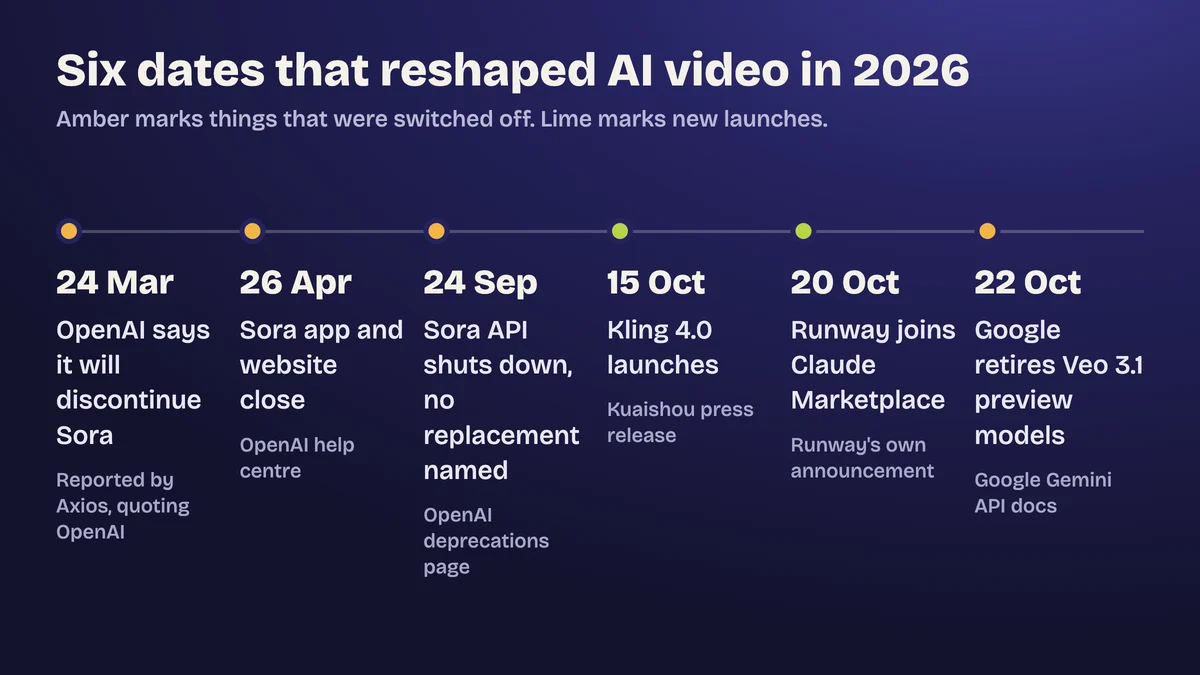
Six Dates That Reshaped AI Video
The timeline above is built from the companies' own pages wherever we could reach them. Where we had to rely on press reports, we say so below.
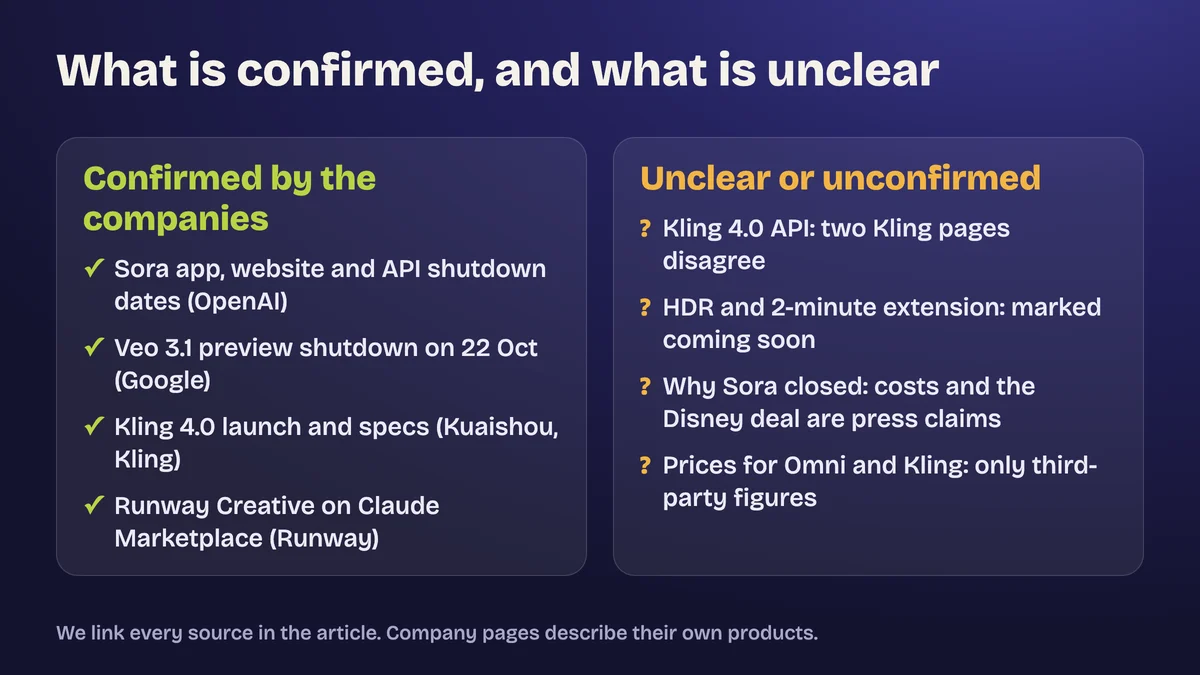
How Sure Are We?
Most of this story is confirmed by the companies. Some details are not, and we have marked those clearly rather than repeat them as fact.
Sora: What Happened
OpenAI announced on 24 March 2026 that it would discontinue Sora, according to Axios and other outlets that quote the company. OpenAI's help centre gives the timeline:
- The Sora web and app experiences were discontinued on 26 April 2026.
- The Sora API was scheduled to be discontinued on 24 September 2026. OpenAI's deprecations page lists the Videos API and the sora-2 and sora-2-pro models with that shutdown date and no recommended replacement.
- People could export their Sora content from sora.chatgpt.com/sunset. OpenAI says it will permanently delete data associated with Sora after any final export window.
Why did OpenAI do it? According to Axios, a company spokesperson said the Sora research team will keep working on world simulation research aimed at robotics. Other reports mention heavy computing costs and an end to a partnership with Disney, but those come from the press, not from OpenAI, and the reports about Disney conflict with each other, so we are not treating them as fact.
For anyone who built a workflow on Sora, the practical point is blunt: the app closed about a month after the announcement, and the API followed about five months later. If your videos, prompts and process lived only inside it, you had to start again.
Google: Veo 3.1 Preview Out, Gemini Omni In
Google's Gemini API documentation says the Veo 3.1 preview models were shut down on 22 October 2026. The affected model names are veo-3.1-generate-preview, veo-3.1-fast-generate-preview and veo-3.1-lite-generate-preview. Developers are told to move to Gemini Omni Flash, whose model ID is gemini-omni-1.1-flash, or to the generally available Veo models on Google's enterprise platform.
For everyday users, Google's Gemini Omni page describes what the Gemini app now offers:
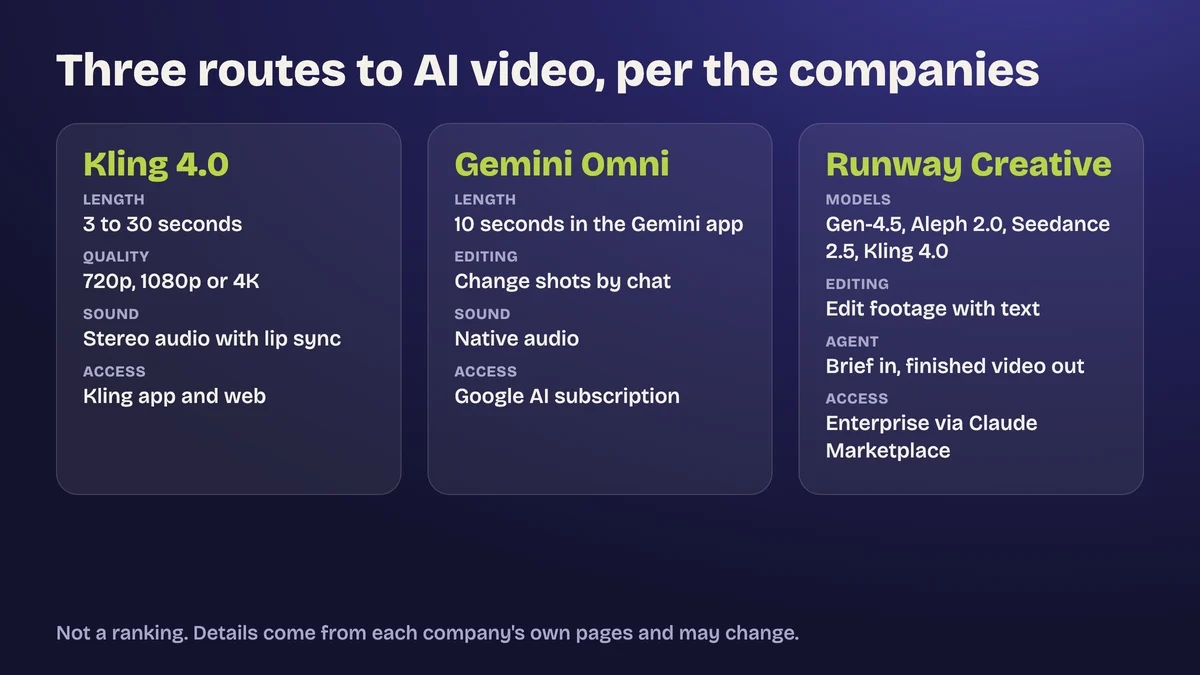
- Videos of 10 seconds with native audio.
- Up to five photos as references.
- Editing by chat, such as swapping characters, changing the lighting or the background, and extending a scene.
- SynthID, a hard-to-see watermark, on every video made in the Gemini app, plus a way to ask Gemini whether Google AI generated an uploaded file.
- A Google AI subscription is required, and features vary by plan and location.
One warning for developers: Google's docs say multi-turn editing works through its Interactions API, and developer reports on GitHub say the switch from Veo is more than changing a model name. Read Google's current docs before you migrate.
Kling 4.0: Longer Clips and More Control
Kuaishou's press release says Kling 4.0 officially launched on 15 October 2026. The Kling user guide lists these specifications:
- Single generations of 3 to 30 seconds, with multi-shot switched on by default.
- Output at 720p, 1080p or 4K.
- Up to 15 reference assets per task, and up to 10 keyframe images.
- Stereo audio with lip sync, and editing of up to five clips.
- A faster Kling 4.0 Flash variant, listed at 3 to 20 seconds and 720p.
Two caveats. First, some features are still marked as coming soon, including video extension of up to two minutes, and the guide is inconsistent about 10-bit HDR output. Second, Kling's own pages disagree on the API: the developer page says the Kling 4.0 API is coming soon, while the API documentation says it is available for early access. And for our region, the languages listed for audio in the part of the guide we read are Chinese, English, Japanese, Korean, Spanish, Portuguese, German, French and Hindi. Arabic is not in that list, so test it before you promise anything to a client.
Runway: A Platform That Hosts Many Models
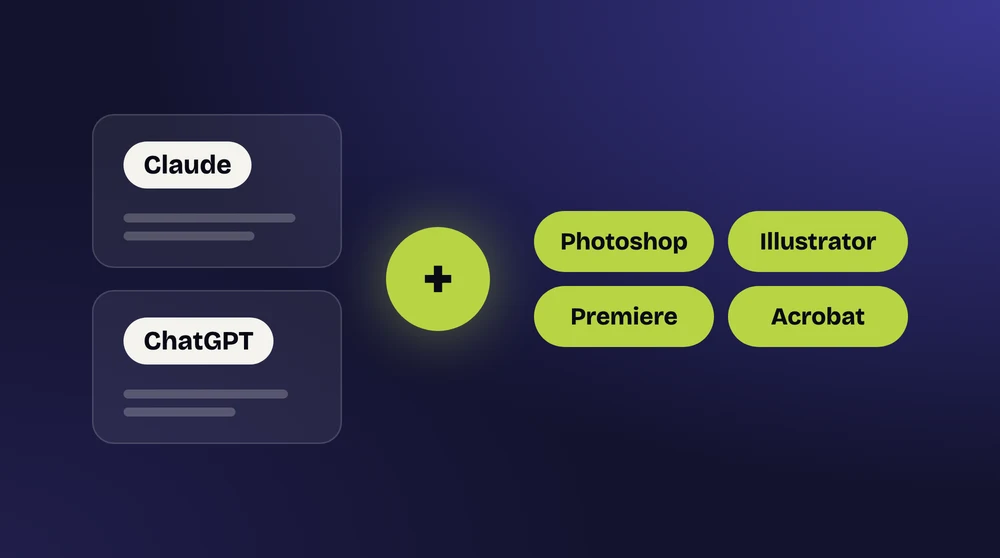
On 20 October 2026, Runway announced that Runway Creative is on Claude Marketplace. Eligible enterprise customers can use part of their existing Anthropic commitment to buy it. Runway says the platform includes Runway Agent, which turns a creative brief into a plan and a finished video, and lists models including Gen-4.5, Aleph 2.0, Seedance 2.5, Kling 4.0 and ElevenLabs V4. Runway also says Claude powers the reasoning behind Runway Agent. No prices are stated.
Runway also offers licences to its model weights for companies that want to fine-tune and run the models themselves, on an annual licence, though it publishes no prices.
Why does this matter? A platform that offers several models gives you a second route if one model disappears. That is the opposite of the Sora situation, although you still depend on the platform.
What This Means for Brands in Oman
We do not make the video tools, so this section is our own view, not a claim by any company. For brands in Oman and the Gulf, three things stand out.
- Arabic needs testing. Voices, lip sync and Arabic text on screen are where many tools are weakest. Check them with your own script before you plan a campaign around a tool.
- Disclosure builds trust. Gemini adds a watermark to its videos, and audiences increasingly ask what is real. Say when something is AI-generated.
- Real footage still matters. For your own people, products and locations, filming is more convincing and avoids surprises.
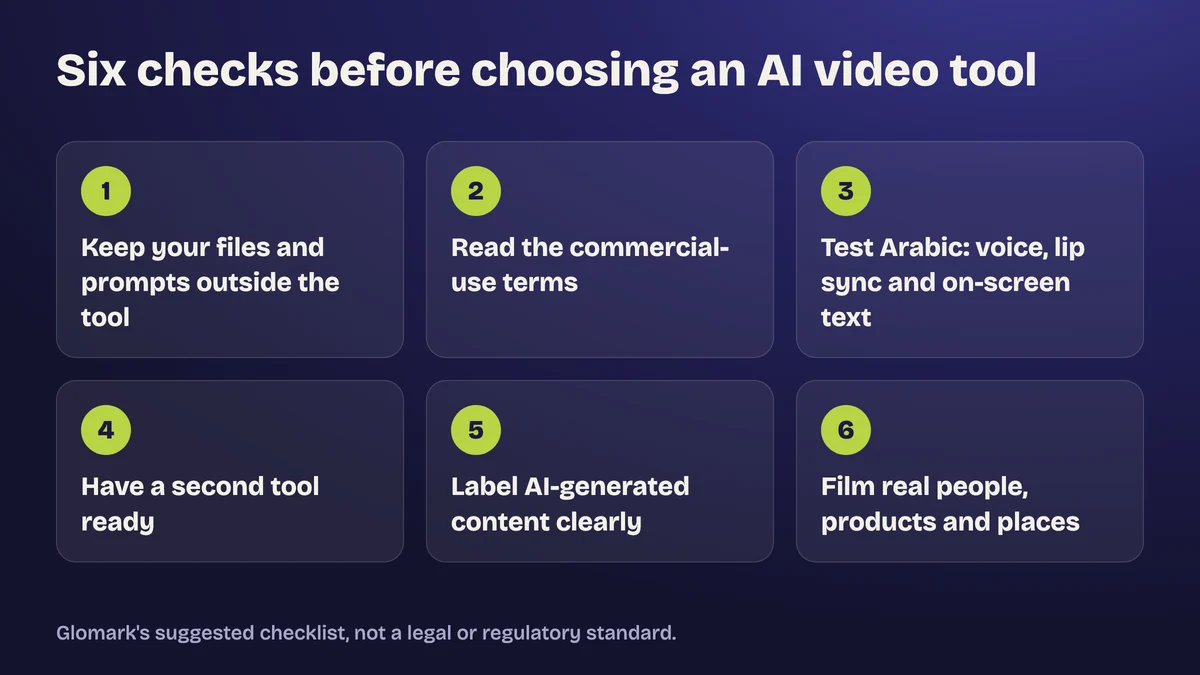
A Six-Point Checklist
- Keep your source files, prompts and exports outside the tool, so you can recreate work elsewhere.
- Read the commercial-use terms before using output in a paid campaign.
- Test Arabic voice, lip sync and on-screen text yourself.
- Have a second tool ready, because shutdowns and migrations are real.
- Label AI-generated content clearly.
- Film real people, products and places, and use AI for what it does well.
Where We Go From Here
We will keep tracking these tools and writing about what changes. If you are weighing AI video for a campaign, our media production team can help you decide what to film and what to generate. For more on how AI is changing marketing work, read our posts on whether AI can run your ad campaigns and this week's AI news, or get in touch.
The cover image and graphics in this article were designed by Glomark from the sources linked above. They are illustrations, not screenshots of any product.